Ottawa weddings increasingly bring two traditions together, and the vocabulary is one of the first practical obstacles — for the families, and for the suppliers they hire.
This is the reference we wish existed when we started. Every term links to the page explaining how we actually decorate for it.
A to Z
Aqiqah
The Islamic celebration held after a birth, when the child is named and the family gathers to give thanks. Traditionally on the seventh day.
Arsi Mushaf
The moment after the nikah when the bride and groom see each other for the first time as a married couple, traditionally in a mirror with the Qur'an held above. A Pakistani and Indian custom.
Baat Pakki
Urdu for 'the matter is settled'. The ceremony where the two families formally agree to the marriage, exchanging gifts and making prayers before the larger engagement.
Barat / Baraat
The groom's wedding procession and the main wedding day event, where the two families meet and the couple sit on the main stage.
Chaddar / Dupatta
The decorated cloth carried over the bride or groom as they enter. Ours are worked with LED lights and flower vines to read under hall lighting.
Chhatri
The Rajasthani ceremonial umbrella, traditionally carried over wedding horses and camels. Worked with peacock, elephant and floral motifs in mirror, bead and shell.
Chunni Chadhai
The Punjabi ceremony where the groom's family presents the bride with a chunni, along with jewellery and gifts.
Darbari
A traditional raised seating arrangement, often used with a takhat for the bride and family at mehndi and mayon.
Dholak
The two-headed hand drum played at dholki, mayoun and traditional sangeet gatherings. The dholki takes its name from it.
Dholki
The informal singing night before a Pakistani wedding, named after the dhol drum. Usually held at home, often over several evenings.
Dua-e-Khair
A gathering for prayer and blessing held before a wedding, asking for good outcomes for the couple. Often women-only and usually at home.
Gajra
A floral string worn in the hair or on the wrists, made from fresh or artificial flowers.
Ghodi
The decorated mare the groom traditionally rides in the barat procession, dressed in embroidered cloth and garlands to signify prosperity. Now usually replaced by a decorated car.
Giddha
The Punjabi folk dance traditionally performed by women in a circle, with clapping and boliyan. Needs a clear round rather than a stage.
Jago
Punjabi for 'wake up'. The night procession where the maternal family carries a decorated pot lit with candles, singing boliyan to the dhol.
Kosha
The couple's seating stage at an Arab wedding reception — the architectural centre of the room and where the couple sit for much of the night.
Kına Gecesi
The Turkish henna night. The bride wears a red veil and henna is presented on a decorated tray with candles. Red and gold is the palette.
Mandap
The four-pillar canopy under which a Hindu wedding ceremony takes place, seating the couple, the priest and the fire.
Mayon / Maiyan
The ceremony opening a Pakistani wedding week. The bride wears yellow and ubtan is applied by female relatives. Also called vatna, maiyun or, in Hindu families, haldi. Traditionally held at both the bride's and the groom's parental homes.
Mehndi / Mehendi
The henna night — the most colourful event of a South Asian wedding, built on marigold, mirror-work and floor seating.
Milni
The formal meeting of the two families as the barat arrives. Male relatives are introduced in matched pairs from the oldest generation down and exchange garlands. It needs several pairs of garlands, not one.
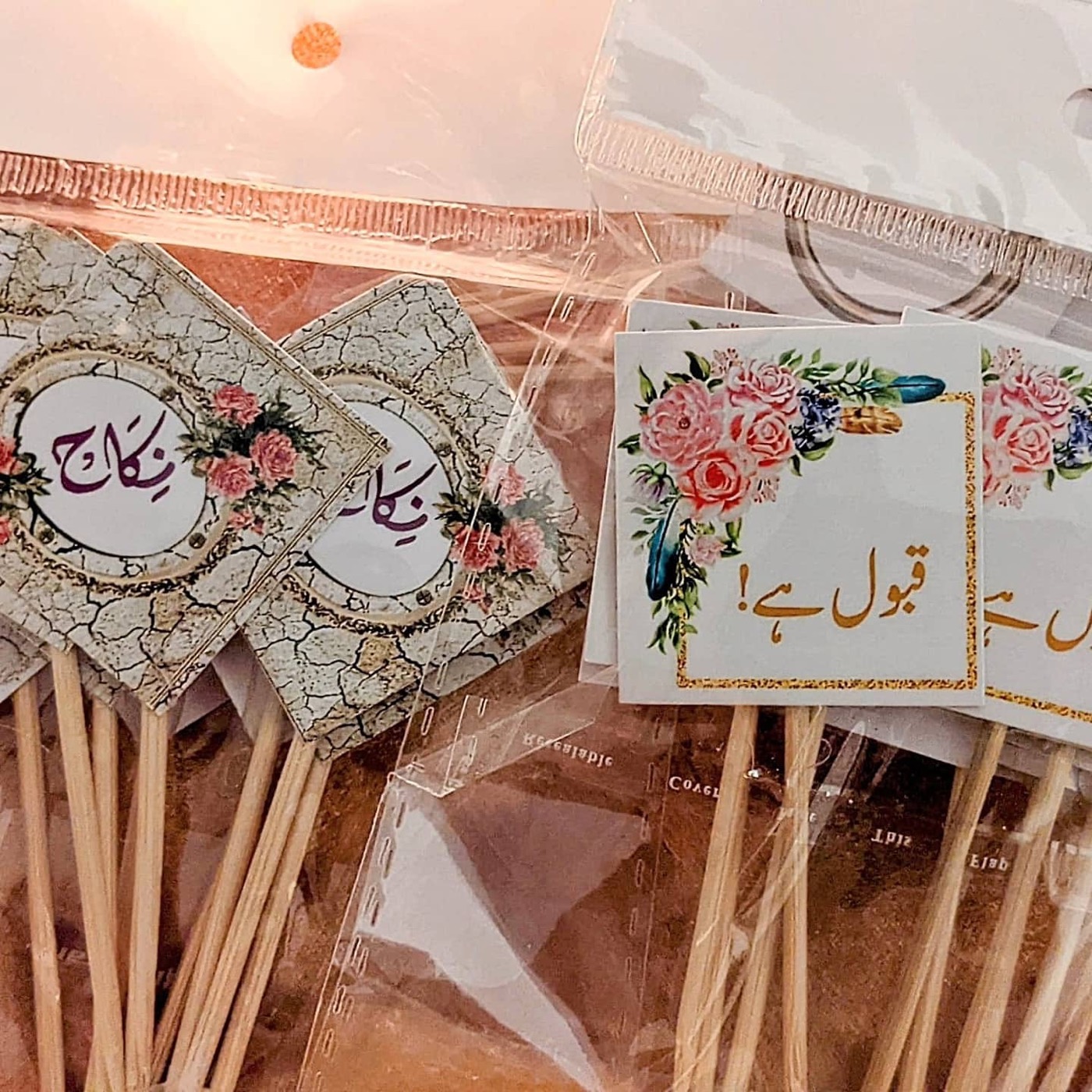
Nikah / Nikkah
The Islamic marriage contract ceremony — the offer, the acceptance, two witnesses and the signing of the nikahnama.
Nişan
The Turkish engagement ceremony, where the rings are tied with a ribbon and cut by a relative.
Phool Patti
The proper name for Pakistani truck art — literally 'flower and leaf'. The tradition of decorating transport traces back to the Indus Valley Civilisation.
Rajasthani Umbrellas
Mirrored, embroidered parasols suspended above a seating area. The most recognisable piece in our mehndi inventory.
Sangeet
The music and dance night, with choreographed family performances. Needs a stage built for performance and a clear floor.
Sehra
The groom's headdress worn during Pakistani, Indian and Bangladeshi weddings, made of flowers, beads and gotta work. It covers the face as a veil — the groom's counterpart to the bride's ghoonghat.
Sehra Bandi
The ceremony of tying the sehra onto the groom, immediately before he leaves home to begin the barat. Performed by the women of his family with songs and blessings.
Shisha
The mirror work found on Rajasthani umbrellas and bridal wear. It traces to 13th-century Persia and is held to reflect away evil and misfortune.
Swayamvar
The ancient practice, recorded from the Vedic period, in which a woman chose her husband from assembled suitors by placing a garland on him. The varmala descends from it.
Takhat
A low traditional seat or platform, dressed with covers and bolsters, used for the couple at mehndi and mayon.
Thal
A decorated tray used to present mehndi, mithai, shagan or the ubtan. Photographed closely, so worth doing properly.
Ubtan
The turmeric paste applied to the bride at the mayon ceremony.
Valima / Walima
The wedding reception traditionally hosted by the groom's family after the nikah. The most formal event of the week.
Varmala / Vermala / Haar
The garland exchange between bride and groom. Made in fresh or artificial flowers.
Zaffa
The Arab wedding procession that brings the couple into the reception, accompanied by drummers and musicians.
Planning across two traditions?
It is a design problem we enjoy and one we have solved many times. Send us both and we will come back with a palette that serves them together.
Good to know
Questions we get asked
The nikah is the marriage contract ceremony — the offer, the acceptance, two witnesses and the signing. It is the moment the marriage legally and religiously takes place.
The walima is the reception that follows, traditionally hosted by the groom's family. One is the ceremony, the other is the celebration.
Mayon opens the wedding week: the bride wears yellow and ubtan is applied by female relatives, usually at home and in a small gathering.
Mehndi is the henna night — larger, louder, built on marigold and mirror-work. Many Ottawa families combine them into one event.
The barat is the groom's wedding procession and, by extension, the main wedding day event. The groom's family travels to the venue, the two families meet, and the couple sit on the main stage.
It is typically the largest event of the week by guest count.
No. Tell us what is happening at your event in whatever words you use, and we will build for it.
This glossary exists because families marrying across traditions often ask, not because we expect anyone to arrive fluent.