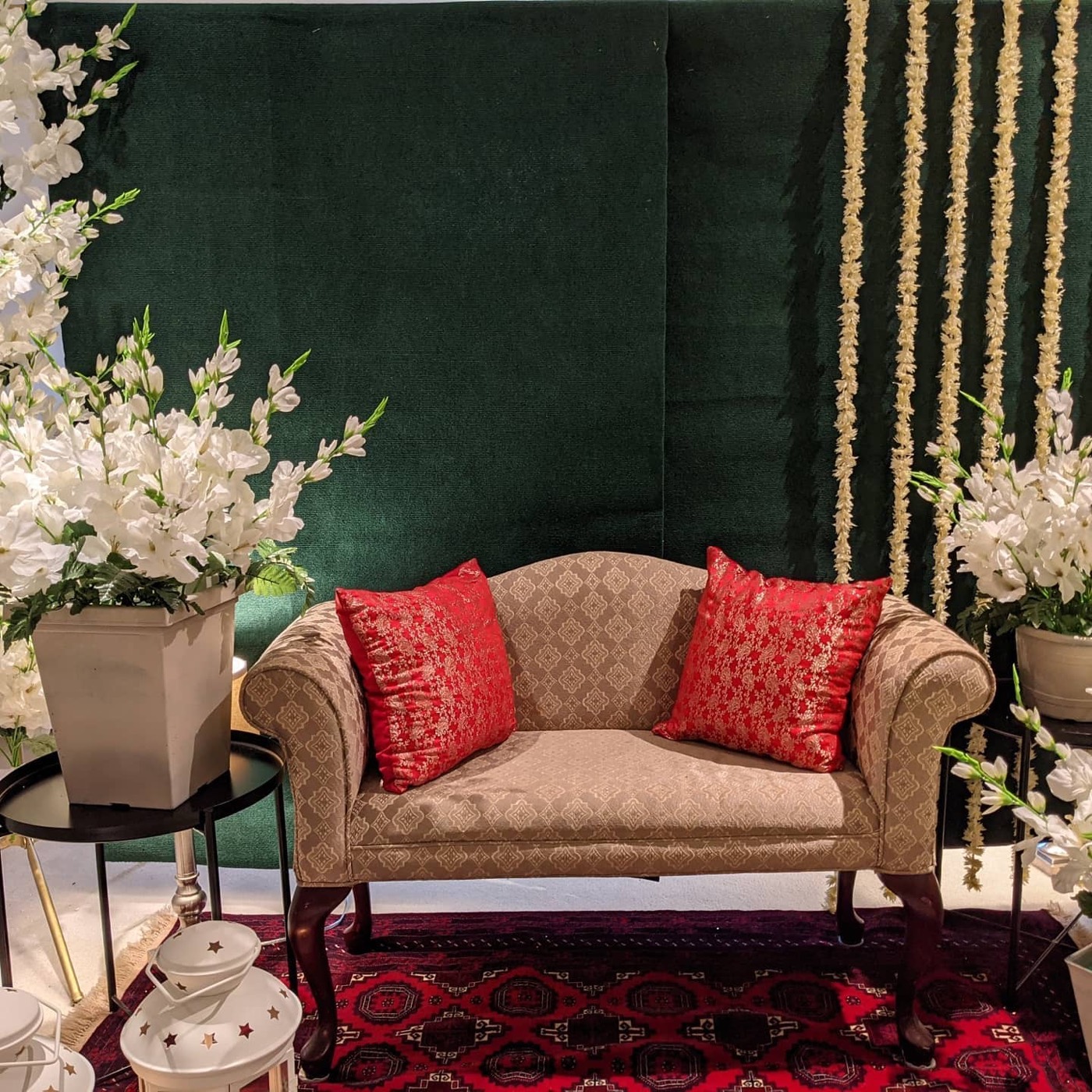
Turkish weddings have their own sequence and their own objects, and they are frequently lumped in with either Arab or South Asian traditions by decorators who have not done one.
We work with Ottawa's Turkish community and we build to the ceremonies as they actually run.
Kına gecesi — the henna night
The kına gecesi is the bride's henna night: red is the colour, the bride wears a red veil, and the henna is presented on a decorated tray with candles while the family sings.
It is closer in feel to a Pakistani mehndi than to anything Western, but the palette rule is different — red and gold rather than marigold and multicolour — and the tray and veil are the ritual centre rather than the stage.
- Red and gold backdrop and seating build
- Decorated henna tray with candles
- Red veil (kırmızı duvak) staging and entry
- Floor seating and low lighting
- Floral installations in red, burgundy and gold
Nişan — the engagement
The nişan is the engagement ceremony where the rings are tied with a ribbon and cut by a relative. It is usually a smaller gathering, often at home or in a restaurant's private room.
We set up a backdrop, couple's seating, and decorated trays for the rings and sweets.
The reception
Turkish receptions run long and lean formal — white and gold, structured drape and a defined couple's stage. The build overlaps closely with what we do for Arab weddings, and we quote them similarly.
Where the celebration combines Turkish and another tradition — which in Ottawa it often does — tell us both and we will design a palette that serves them together rather than alternating between them.
Red is the rule at a kına gecesi, and it is not negotiable
The kına gecesi has a stricter colour convention than most henna nights. The bride wears a red veil — the kırmızı duvak — and red runs through the whole evening.
This trips up families planning a Turkish henna night alongside a Western or South Asian celebration, because the instinct is to carry one palette across every event. Here you should not. A pastel kına gecesi reads as wrong to anyone who knows the tradition, in the same way a white mehndi would.
Red, burgundy and gold, with candlelight. We build to that and we will say so if you ask for something else.
The tray and the veil are the two objects that matter
Unlike a South Asian mehndi, where the stage carries the evening, the kına gecesi is organised around two ritual objects.
The henna tray is carried in with candles, usually by the bride's friends, while the family sings — it is held, moved and photographed at close range all evening, so it deserves proper making rather than a decorated plate.
The red veil covers the bride while the henna is placed in her palm and a gold coin closed into it. The moment the veil is lifted is the photograph of the night, which means the lighting and the backdrop behind her have to work for a seated, veiled subject rather than a standing couple.
We build the seating and lighting around that specific moment.
Where Turkish weddings sit in Ottawa
Ottawa's Turkish community is smaller than its Pakistani or Indian communities, which has two practical effects.
First, almost nobody here decorates specifically for Turkish traditions — kına gecesi and nişan get folded into a generic 'henna night' or 'engagement' package by suppliers who have not done one. Second, many Turkish weddings in Ottawa are mixed-tradition, because the community is small enough that marrying across it is common.
Both are reasons to say what you are actually having. We build for the ceremony rather than to a template, and where two traditions are being combined we will design a palette that genuinely serves both instead of alternating between them.
Tell us your date
Send your date, venue and guest count on WhatsApp. Faya will come back to you directly with what fits and what it costs.
Good to know
Questions we get asked
It is the Turkish henna night held before the wedding. The bride wears a red veil, henna is presented on a decorated tray with candles, and the family sings traditional songs.
Red and gold is the palette rule — it is distinct from a South Asian mehndi, which runs marigold and multicolour.
Yes — the decorated tray with candles is the ritual centre of the kına gecesi, and it is photographed closely.
We make it in your palette alongside the rest of the setup.
Yes. Backdrop, couple's seating and decorated trays for the rings and sweets. These are usually smaller gatherings at home or in a restaurant private room.
Restaurant venues have short access windows, so tell us the venue early.
Yes, and it is common in Ottawa. Rather than alternating between two looks across the events, we will design a palette that genuinely serves both.
Tell us both traditions at enquiry — it is a design problem we enjoy.
The kına gecesi and the reception are the two main builds. Cost depends on venue size, ceiling height and how much floral work is involved.
WhatsApp +1 (613) 883-4969 with your dates and venues.
Red — it is a stricter convention than most henna nights. The bride wears the kırmızı duvak, the red veil, and red runs through the evening, usually with burgundy, gold and candlelight.
A pastel kına gecesi reads as wrong to anyone who knows the tradition, in the same way a white mehndi would.
The henna tray and the red veil. The tray is carried in with candles while the family sings, and is handled and photographed at close range all evening. The veil covers the bride while henna and a gold coin are placed in her palm.
The moment the veil lifts is the photograph of the night, so we build the seating and lighting around a seated, veiled subject.
Most fold kına gecesi and nişan into a generic 'henna night' or 'engagement' package, because the community here is small and few have done one.
We build for the ceremony as it actually runs. And because many Turkish weddings in Ottawa are mixed-tradition, tell us both — we will design a palette that serves them together rather than alternating.