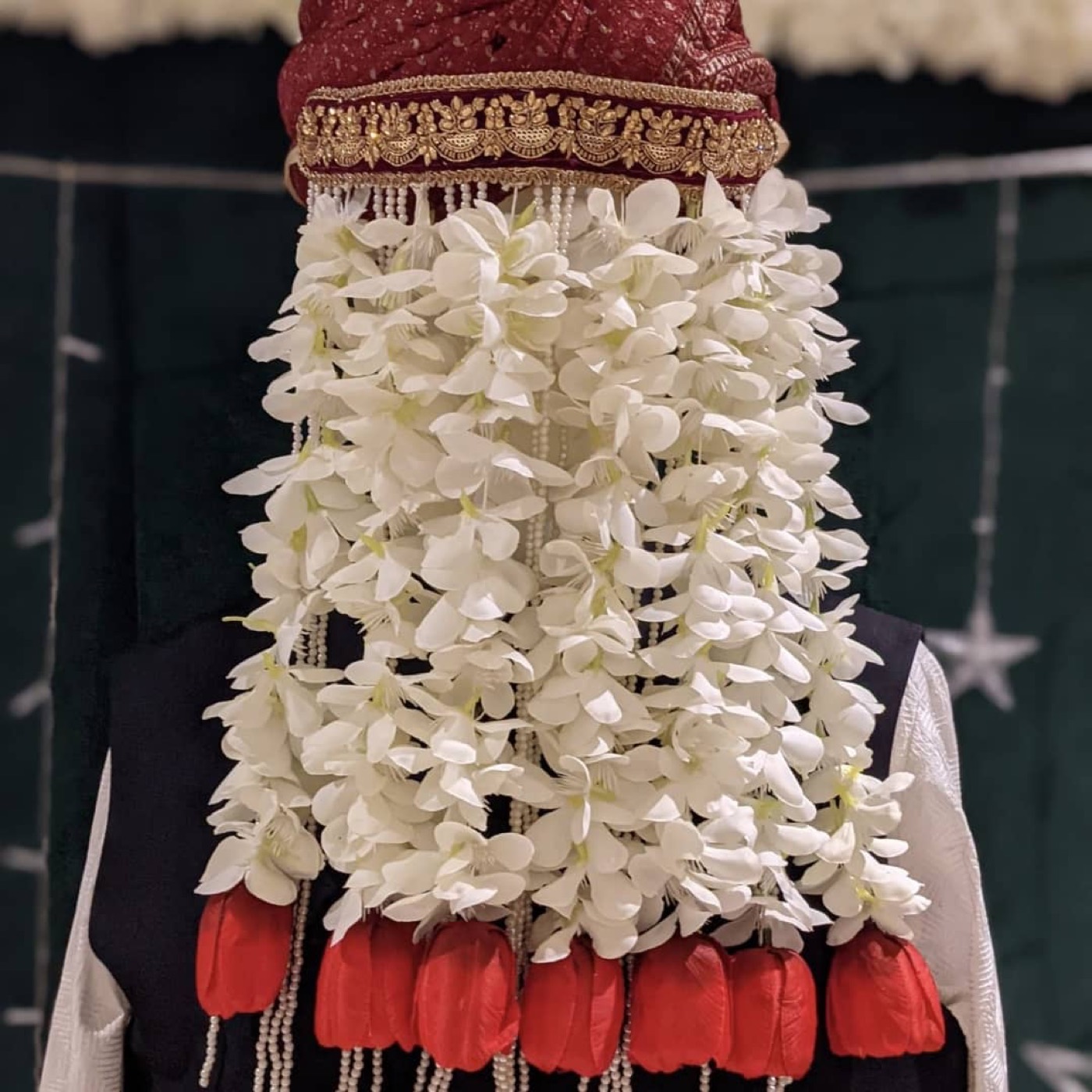
A sehra is the headdress worn by the groom during Pakistani, Indian and Bangladeshi weddings. The decorated dupatta — chaddar — is carried over the bride or groom as they enter.
Both are made to order. Both are almost impossible to source properly in Ottawa, which is why we make them ourselves.
The sehra
We make traditional floral sehras — flowers, beads and gotta-worked headpiece — and beaded sehras for families who want something that survives the night intact and can be kept afterwards.
The construction matters more than it looks. A sehra hangs in front of the face for hours and is repeatedly lifted; one built for a photograph rather than for wearing will not last the barat.
- Traditional floral sehra with gotta work
- Beaded sehras
- Made in your palette
- Matching boutonniere and garland available
The decorated dupatta / chaddar
Our entry dupattas are heavily decorated and worked with LED lights and flower vines so they read under dim hall lighting — which is where the entrance almost always happens.
They are used for mehndi, mayon, sangeet and barat entries, and for both bride and groom.
- LED-lit flower vine work
- Bride and groom versions
- Made for mehndi, mayon, sangeet and barat
- Matched to your outfit palette
Lead time
These are made pieces, not stock. Custom colours need a few weeks, and peak-season dates should be booked well ahead.
Send a photograph of the outfit fabric when you enquire — it is the single most useful thing for matching.
What gotta work is, and why it costs what it does
Gotta is the flat metallic ribbon — traditionally gold or silver — applied by hand in loops, edges and floral shapes. It is the detail that separates a sehra made properly from one assembled from craft-shop materials, and it is entirely hand work.
That is where the lead time goes. A gotta-worked sehra is not stock; it is made, in your palette, and a few weeks' notice is the difference between the piece you wanted and the piece that was possible.
Floral or beaded — a real decision
Traditional floral sehra
Fresh or artificial flowers with beads and gotta, hanging in front of the face. This is the traditional form and the one most families picture. Made fresh it is at its best for a few hours; made artificial it survives the whole barat and the drive.
Beaded sehra
Beads and gotta without fresh floral, built to last. Families choose this when they want to keep it afterwards, and increasingly when the barat runs long or the wedding is in an Ottawa winter where fresh will not survive the walk from the car.
The dupatta is a lighting problem
The entry chaddar is carried over the bride or groom as they come in — and the entrance almost always happens in the dimmest part of the evening, in a hall with the house lights down.
A beautifully embroidered dupatta photographs as a dark shape in those conditions. That is why ours are worked with LED lights and flower vines: the light is in the piece rather than relying on the room. It is the single most practical thing about how we make them, and it is the reason entry photographs from our setups are usable rather than murky.
Matching to the outfit
Send a photograph of the actual fabric. Not a colour name — a photograph. Outfit colours are notoriously hard to describe, shop lighting distorts them, and 'maroon' covers about forty shades.
We match to the material. For a groom's sehra we also want to see the kurta or sherwani, because a sehra that is correct in isolation and wrong against the outfit is a wasted piece.
Sehra Bandi — the ceremony the sehra exists for
The sehra is not just an accessory the groom puts on. It has its own ceremony, and most families planning a wedding in Ottawa do not book anything for it.
Sehra bandi — sehra, the garland headgear, and bandi, to tie — is the moment the sehra is tied onto the groom, immediately before he leaves his family home to begin the barat. It is performed by the women of his family: his mother, his sisters, his bhabhi, with songs, blessings and in some families poetry.
It is short, it is emotional, and it is the groom's equivalent of everything the bride's side has been doing all week. The sehra itself covers his face and works as a veil — the counterpart to the bride's ghoonghat — and it marks his change from bachelor to husband. Traditionally it is understood as a symbol of honour and dignity.
And it happens in a hallway, because nobody thought to decorate for it.
The groom's home is the under-decorated venue
This is the practical gap we see most often in Ottawa. Everything gets booked for the bride's side — her mayoun, her mehndi, her rukhsati — and the groom's home gets nothing, despite three photographed things happening there on the same morning:
The groom's mayoun, which traditionally takes place at his parents' home just as the bride's does at hers. The sehra bandi, with his mother and sisters around him. And the decorated car pulling away with the barat behind it.
One modest setup at the groom's house covers all three, and it costs a fraction of a hall build. If you are the groom's family and have been told there is nothing to book, this is the thing to book.
- A backdrop or seating area for the sehra bandi and the groom's mayoun
- Entry and doorway décor for the departure
- Stair décor where the house is a two-storey
- The car, decorated on the driveway before it leaves
- Garlands for the milni, which the groom's side carries
Building a sehra that hangs correctly
Because the sehra veils the face, how it hangs matters as much as how it looks. Too long and he cannot see to walk; too short and it sits on the forehead rather than falling; too heavy at the front and it tips forward off the turban all evening.
It is tied onto the turban, so we need to know the turban — its height, its style, and whether it is being tied on the day by someone else. A sehra made for a flat head-height and then fitted over a tall Punjabi pagri will hang wrong and there is no fixing it at the door.
Send us a photograph of the turban, or tell us who is tying it. It is the same principle as sending fabric for colour matching: the physical object beats a description every time.
Tell us your date
Send your date, venue and guest count on WhatsApp. Faya will come back to you directly with what fits and what it costs.
Good to know
Questions we get asked
A sehra is the headdress worn by the groom during Pakistani, Indian and Bangladeshi weddings — traditionally made of flowers, beads and gotta work, hanging in front of the face during the barat.
We make both traditional floral and beaded versions.
It is the decorated cloth carried over the bride or groom as they enter — used at mehndi, mayon, sangeet and barat entries.
Ours are worked with LED lights and flower vines so they read under dim hall lighting, which is where entrances almost always happen.
Custom colours need a few weeks. Peak-season dates should be booked well ahead so the date is held.
Send a photo of the outfit fabric with your enquiry for accurate matching.
Beaded sehras are made to be kept. Fresh floral sehras are made for the day.
Tell us which you want when you enquire — it changes the construction.
Gotta is flat metallic ribbon, traditionally gold or silver, applied by hand in loops, edges and floral shapes. It is the traditional embellishment on a sehra and it is entirely hand work.
That hand work is where the lead time comes from — a gotta-worked sehra is made to order, not taken from stock.
Floral is traditional and looks best for a few hours. Beaded lasts the whole day, survives an Ottawa winter, and can be kept afterwards.
For a long barat, a winter wedding, or a family that wants to keep the piece, beaded is usually the better call.
Because the entrance happens in the dark. A hall with the house lights down turns a beautifully embroidered dupatta into a dark shape in every photograph.
Working LED and flower vines into the piece puts the light where it is needed rather than relying on the room, which is why entry photographs from our setups are usable.
A few weeks for custom colours, and longer for a peak-season date so the slot is held.
These are made pieces, not stock. Short notice is worth asking about, but a specific gotta-worked colour cannot be conjured in four days.
It is the ceremony of tying the sehra onto the groom, immediately before he leaves home to begin the barat. Sehra means the garland headgear and bandi means to tie.
It is performed by the women of his family — mother, sisters, bhabhi — with songs and blessings, and it marks his change from bachelor to husband.
It works as a veil — the groom's counterpart to the bride's ghoonghat — and is traditionally understood as a symbol of honour and dignity.
That is also why the way it hangs matters as much as how it looks: too long and he cannot see, too short and it sits on the forehead instead of falling.
In our experience it is the most under-booked setup in an Ottawa wedding. Three photographed things happen there on the same morning — the groom's mayoun, the sehra bandi, and the decorated car leaving with the barat.
One modest setup covers all three and costs a fraction of a hall build. If you are the groom's family and have been told there is nothing to book, this is it.
The turban — its height, its style, and who is tying it on the day. A sehra made for a flat head-height and then fitted over a tall pagri will hang wrong, and it cannot be fixed at the door.
Send a photograph of the turban and of the sherwani fabric. The physical object beats a description every time.