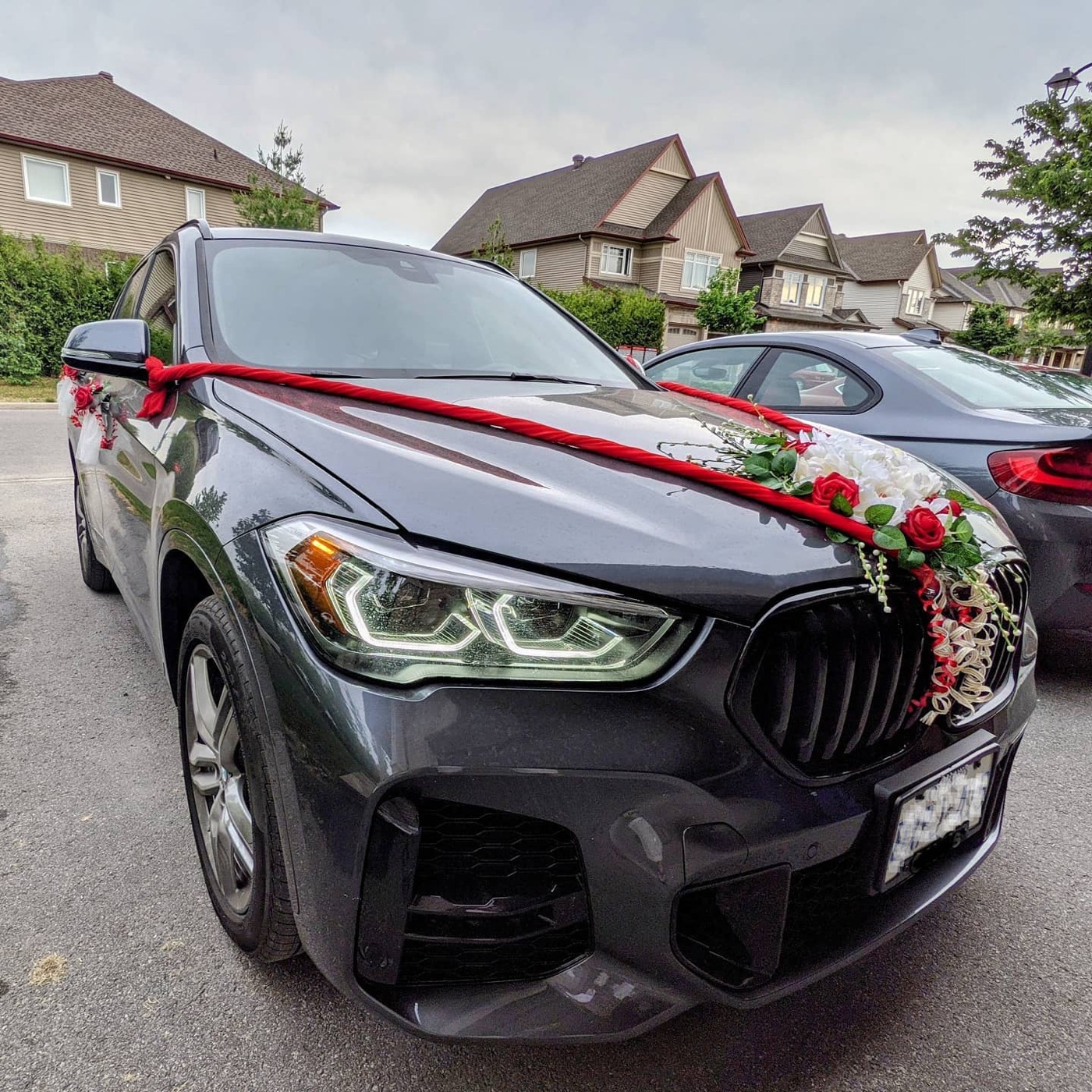
The wedding car appears in every version of the video and every family album. It is one of the cheapest pieces of décor at a wedding and one of the most reliably photographed.
We decorate at your home before departure so the car leaves finished.
What we do
- Floral bonnet and roof work — fresh or artificial
- Ribbon and garland dressing
- Truck-art style decoration — the Pakistani folk-art look, in full colour
- Door and handle florals
- Matched to the wedding palette
- Set up at the house before departure
Truck art
This is the piece almost nobody else in Ottawa offers. Pakistani truck art — dense, bright, patterned — applied to a wedding car gives the barat an arrival with genuine character rather than a ribbon across a bonnet.
It takes longer to make and it is worth booking ahead.
Fresh or artificial on a car
For winter weddings, artificial. Fresh flowers on a car in an Ottawa January do not survive the drive, and there is no point paying for something that arrives dead.
In summer, fresh works well if the drive is short. We will ask about the route before recommending.
The doli, and why the car matters more than people expect
The wedding car is the doli. Traditionally the bride left her parents' home in a covered palanquin carried by her brothers; today it is a car, but the meaning has not moved — it marks the moment she leaves.
Practically, that makes the car the backdrop for the rukhsati, which is filmed continuously by everyone present and is the most emotional footage of the week. A ribbon across a bonnet is a missed opportunity in a way that few other small bookings are.
Truck art — the thing almost nobody in Ottawa offers
Pakistani truck art is a genuine folk tradition: dense, saturated pattern, mirrored panels, floral motifs and hand-lettering, originally painted across cargo trucks and buses.
Applied to a wedding car it produces an arrival with real character rather than a generic floral bonnet. It is the most distinctive thing we make in this category and we have not found another Ottawa decorator offering it.
It takes longer to prepare than floral work, so it needs booking further ahead.
What we actually put on a car
- Bonnet and roof floral work — the main visual, sized so it does not obstruct the driver's view
- Garland work across the front, in fresh or artificial
- Ribbon along the bonnet and to the wing mirrors
- Door and handle florals — small, and the detail in every photograph of the bride getting in
- Truck-art panels where booked
- Matched to the wedding palette rather than a default red
Winter, and the mistake we see most
Fresh flowers on a car in an Ottawa January do not survive the drive. Wind chill at road speed finishes them, and there is no sense paying for flowers that arrive dead.
For any wedding between roughly November and April we recommend artificial on the car without hesitation. It holds an exact colour, it survives the route, and nobody can tell in a photograph taken from more than a foot away.
The second mistake is fixing method. We use nothing that marks paintwork or scratches a clear coat — no suction cups on a cold windscreen, no tape on a warm bonnet. If the car is a rental or a borrowed family vehicle, tell us, and we will be correspondingly careful.
Phool patti — the real name for truck art
Pakistani truck art has a name, and for a florist it is a good one: phool patti, literally flower and leaf. In the earliest stage of the tradition only simple floral motifs were used, and the name stuck even after the work became far more elaborate.
It is not confined to trucks. Phool patti covers ice-cream carts, tractors, buses, tuk-tuks and minivans — anything that moves is decorated.
So when we do truck-art work on a wedding car, we are not applying a novelty finish. We are doing the thing the tradition is actually named after, on a vehicle, in flowers and leaves.
A tradition older than the trucks
The decorating of transport in this region traces back to the Indus Valley Civilisation (roughly 2600–1700 BC), where boats and transport animals were beautified, and it continued through the Mughal Empire and British India.
The modern form dates to the 1920s, when Bedford trucks arrived on the roads. By the late 1940s drivers were ornamenting them with floral work alongside portraits of Sufi saints; political themes appeared in the 1960s. Each region of Pakistan developed its own style.
There is a direct line from decorating a wedding animal to decorating a wedding car — the ghodi and the doli are the same idea, four thousand years apart. That is genuinely what a decorated barat car is: the oldest continuous decorating tradition in the region, applied to a Honda in a Barrhaven driveway.
What we can and cannot do on a car
An honest limit worth stating. We do floral and applied truck-art work — dense pattern, mirrored elements, floral and leaf motifs, hand-worked panels attached to the vehicle. We do not paint vehicles.
Everything is removable and nothing marks paintwork: no suction cups on cold glass, no tape on a warm bonnet, no adhesive on a clear coat. If the car is a rental, a lease or a borrowed family vehicle, say so at booking and we will be correspondingly conservative in how it is fixed.
Sightlines are the other constraint. Nothing goes where it obstructs the driver's view or the wipers, and nothing sits where it will lift at road speed. That last one rules out some designs people bring us from photographs taken of stationary cars.
Tell us your date
Send your date, venue and guest count on WhatsApp. Faya will come back to you directly with what fits and what it costs.
Good to know
Questions we get asked
Yes — we come to you and decorate before departure, so the car leaves finished.
Tell us the address and the departure time when you book.
It is the Pakistani folk-art style — dense, bright, heavily patterned — applied to the wedding car. It is one of the more distinctive things we make and very few decorators in Ottawa offer it.
It needs booking ahead as it takes longer to prepare.
For Ottawa winter weddings, artificial — fresh does not survive the drive and there is no sense paying for flowers that arrive dead.
In summer, fresh works well over a short route. Tell us the drive and we will advise.
It is one of our smaller bookings and is often added to a barat or nikah booking.
WhatsApp +1 (613) 883-4969 with your date and what you have in mind.
The doli is the transport that carries the bride from her parents' home at the rukhsati. Traditionally a covered palanquin carried by her brothers; today it is a car — a vintage rental, a limousine or the family's own vehicle, decorated for the occasion.
It is the backdrop for the most-filmed and most emotional part of the wedding.
Pakistani truck art is a folk tradition of dense, saturated pattern, mirrored panels and floral motifs, originally painted across cargo trucks. Applied to a wedding car it gives the arrival real character rather than a generic floral bonnet.
It is the most distinctive thing we make in this category, and we have not found another Ottawa decorator offering it. It needs booking further ahead than floral work.
No. We use nothing that marks paintwork or scratches a clear coat — no suction cups on a cold windscreen, no tape on a warm bonnet.
If the car is a rental or a borrowed family vehicle, tell us and we will be correspondingly careful. It is worth mentioning at booking.
For any wedding between roughly November and April, artificial without hesitation. Wind chill at road speed finishes fresh flowers, and there is no sense paying for something that arrives dead.
In summer over a short route fresh works well. Tell us the drive and we will advise honestly.
It is the actual name for Pakistani truck art, and it literally means "flower and leaf". In the earliest stage of the tradition only simple floral motifs were used, and the name persisted as the work grew more elaborate.
It covers not just trucks but ice-cream carts, tractors, buses and tuk-tuks — anything that moves.
The decorating of transport in the region traces to the Indus Valley Civilisation, roughly 2600–1700 BC, where boats and transport animals were beautified, and it continued through the Mughal Empire.
The modern form dates to the 1920s and the arrival of Bedford trucks. By the late 1940s drivers were adding floral work and portraits of Sufi saints.
No. We do floral and applied truck-art work — dense pattern, mirrored elements, hand-worked panels attached to the vehicle. Everything is removable and nothing marks paintwork.
If the car is a rental, a lease or borrowed, tell us at booking and we will be more conservative in how it is fixed.
Anything that obstructs the driver's view or the wipers, and anything that will lift at road speed.
That rules out some designs clients bring us from photographs — those cars were stationary. We will always tell you which part of a reference image is not drivable.