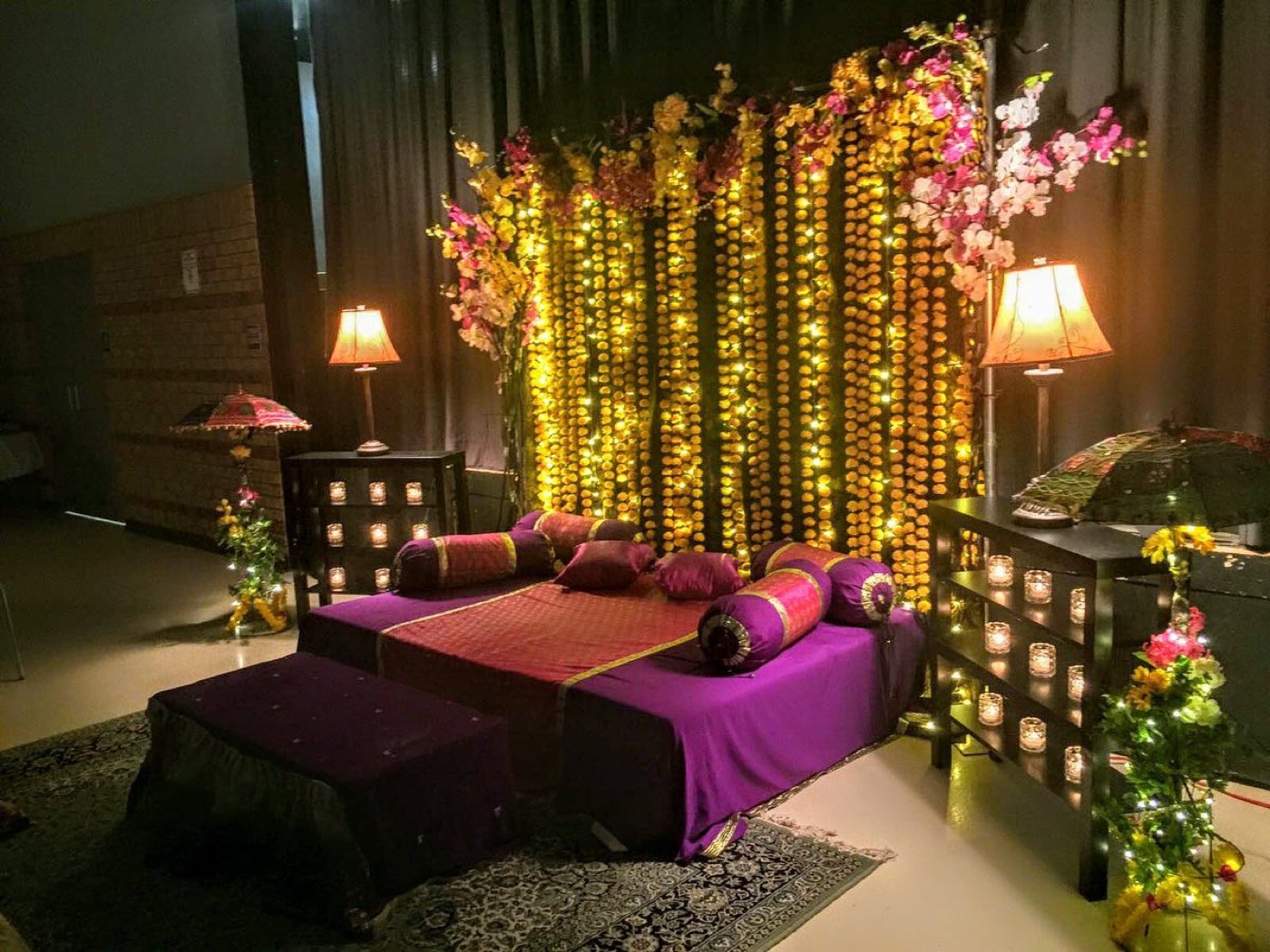
Jago means 'wake up'. The maternal family carries a decorated pot — the jago — lit with candles or lights, and the celebration moves through the house and the street with singing, dhol and boliyan.
It is a Punjabi tradition, it is loud, and it is one of the most visually distinctive nights in any wedding week. Almost nobody in Ottawa decorates specifically for it. We do.
The jago pot
The gaggar — the pot itself — is the centre of the night. We decorate jago pots with florals, mirror-work, gotta and lighting, built to be carried on a head and passed between people without falling apart.
That last part matters more than it sounds. A pot decorated for a photograph and a pot decorated to survive an hour of dancing are different objects.
The rest of the setup
- Backdrop and stage for the singing and boliyan
- Floor seating with bolsters and appliqué sheets
- Fairy light curtains and LED string
- Rajasthani lanterns hung overhead
- Decorated thal for the mithai and shagan
- Entry décor for the doorway the procession passes through
Jago in an Ottawa winter
Traditionally the jago moves outdoors. In Ottawa that is a real constraint for eight months of the year, and we plan around it rather than pretend otherwise.
For winter jagos we build the procession route indoors — hallway, stairs and entry décor — so the movement still happens and the photographs still work. Stair décor is genuinely one of our most-requested pieces for exactly this reason.
What the gaggar has to survive
The gaggar — the decorated pot — is not a centrepiece. It is carried on a head, passed between people, danced with, and handled by a dozen relatives across an evening, most of whom are not being careful.
That is a construction requirement, not a decorative one. We build them with the decoration secured rather than perched: floral and mirror-work fixed to withstand handling, lighting wired so nothing hangs loose to be caught, and weight kept low and balanced so the pot sits on a head rather than fighting it.
A pot decorated for a photograph looks identical to one decorated to be carried, right up until forty minutes into the dancing. We build the second kind.
Lighting the pot itself
Traditionally the gaggar holds oil lamps or candles. In a modern Ottawa jago — indoors, in a carpeted house, being danced with — open flame is a genuine hazard, and most families have already moved to LED.
We fit battery LED lighting inside and around the pot. It photographs almost identically, it survives being tilted, and nobody's dupatta catches.
If your family keeps the traditional oil lamp, tell us and we will build for it — but we will also be direct with you about where it can and cannot safely be carried.
The Ottawa winter jago, in detail
The jago is a procession. For roughly eight months of the year in this city, processing outdoors is not realistic — and jagos cluster in wedding season but by no means only in summer.
So we build the route indoors and treat it as a designed sequence rather than a single backdrop: the entry, the hallway, and above all the staircase, which in an Ottawa two-storey is where the procession naturally moves and where the best footage comes from.
Stair décor is one of our most requested single pieces, and winter jagos are a large part of why. It also does double duty if there is a rukhsati later in the week using the same staircase.
Boliyan, and building for a room that will be loud
A jago is not a seated event. There is singing, call-and-response boliyan, a dhol, and people moving constantly between rooms.
The décor has to stay out of the way of that. Nothing freestanding in a doorway or at the bottom of the stairs. Nothing at head height where a raised arm goes. Floor seating around the edges rather than through the middle, so the centre stays clear.
It is the same principle as a sangeet stage: if people have come to move, the build has to leave them room to do it.
Tell us your date
Send your date, venue and guest count on WhatsApp. Faya will come back to you directly with what fits and what it costs.
Good to know
Questions we get asked
Jago means 'wake up'. The bride's or groom's maternal family carries a decorated pot — the gaggar — lit with candles or lights, singing boliyan and dancing to the dhol. It traditionally moves through the neighbourhood, waking everyone.
It is a Punjabi pre-wedding tradition and one of the liveliest nights of the week.
Yes. We decorate the gaggar with florals, mirror-work, gotta and lighting, and we build them to be carried and passed around rather than just photographed.
A pot that looks good but comes apart during the dancing is not much use, so we construct them accordingly.
Yes, and in Ottawa it usually has to. We build the procession route indoors — entry, hallway and stair décor — so the movement and the photographs still work without anyone standing outside in February.
Stair décor is one of our most requested items for exactly this.
It is usually a smaller booking than a mehndi or sangeet, often added to another event in the same week. Cost depends on whether you need only the decorated pot or a full setup with backdrop, seating and lighting.
WhatsApp +1 (613) 883-4969 and Faya will quote it.
Yes. Jago, sangeet, mehndi, chunni, anand karaj receptions and the reception itself — we work across Punjabi weddings in Ottawa and we know the sequence.
See our Punjabi wedding décor page for the full picture.
By securing rather than perching. Floral and mirror-work fixed to withstand handling, lighting wired with nothing hanging loose to catch, and weight kept low and balanced so it sits on a head rather than fighting it.
A pot decorated for a photograph looks identical to one built to be carried, until forty minutes into the dancing.
We fit battery LED as standard. Traditionally the pot holds oil lamps, but indoors on a carpet while being danced with, open flame is a genuine hazard and most families have already moved to LED.
If your family keeps the traditional lamp we will build for it — and be direct about where it can safely be carried.
We build the procession route indoors as a designed sequence: entry, hallway and above all the staircase, which in a two-storey home is where the procession naturally moves and where the best footage comes from.
Stair décor is one of our most requested pieces and winter jagos are a large part of why.
Around the edges, never through the middle. Nothing freestanding in a doorway or at the foot of the stairs, nothing at head height where a raised arm goes, and floor seating at the perimeter so the centre stays clear.
People have come to move — the build has to leave them room.