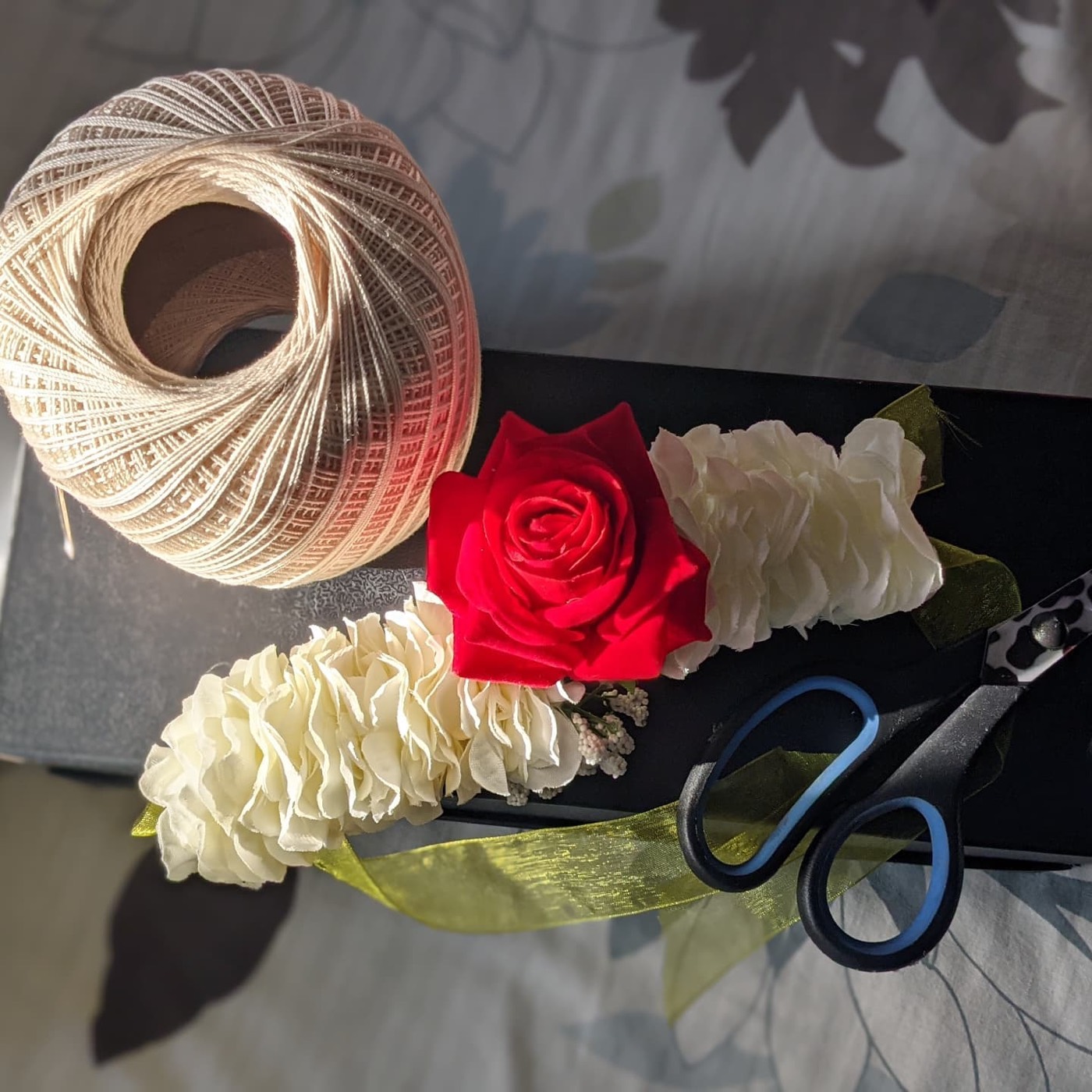
Floral jewellery is worn on the body for hours, photographed at close range, and handled constantly. It is the least forgiving thing we make and the most rewarding when it is right.
We make both real and artificial, and we will tell you which suits your event rather than defaulting to one.
What we make
- Bridal floral jewellery sets — real mums, roses and carnations, or artificial
- Gajras — for the hair and the wrists
- Mums bangles — made in real flowers
- Varmala, vermala and haar — the garland exchange
- Corsages and boutonnieres — real or artificial, customised colour and design
- Bridal and bridesmaid bouquets
- Groom's boutonniere and party sets
Real or artificial — the honest trade
Real flower jewellery is unmatched up close. It is also made within a day of the event, it does not enjoy heat, and in an Ottawa winter it suffers badly in the walk from a car to a building.
Artificial can be made weeks ahead in an exact colour, survives a full day across multiple venues, and can be kept afterwards. For mehndi and barat — long days, lots of movement — it is usually the right choice.
We are happy to mix within one wedding: real for the close-up bridal set, artificial for the garlands worn all night.
Matching your outfit
Send a photograph of the actual fabric. It is genuinely more useful than a colour name — 'maroon' spans about forty shades, and outfit photos taken under shop lighting are rarely accurate.
Custom artificial colours need a few weeks. Fresh depends on what the market holds that week, and we will tell you plainly what is achievable rather than promising a shade nobody can source.
Why mums are the workhorse flower
Chrysanthemums do most of the load-bearing work in real flower jewellery, and there is a practical reason. The heads are dense, they hold their shape when wired, and they survive being worn against skin for hours without collapsing — which roses, for all their beauty, do not do as reliably.
That is why mums bangles are one of the pieces we are asked for most. Roses and carnations go in for colour and scale; mums are the structure underneath.
The pieces, and who wears what
- Bridal set — typically a necklace, earrings, a maang tikka and bangles, made as one matched set
- Gajra — worn in the hair, around a bun, or on the wrists; the most commonly ordered single piece
- Mums bangles — real flower bangles, dense enough to hold their shape all evening
- Varmala, haar — the exchange garlands for bride and groom
- Corsages and boutonnieres — for parents, siblings and the wedding party, in real or artificial
- Kalire and hath phool on request
Do not forget the milni garlands
The garland everybody remembers to order is the couple's varmala. The set almost everybody forgets is the milni.
When the barat arrives, relatives from each family are introduced in matched pairs — fathers with fathers, uncles with uncles, working from the oldest generation down — and each pair exchanges garlands. That needs four to eight pairs depending on family size, and it is a separate order from the varmala.
We are asked for these at short notice more often than for anything else we make, usually two or three days before the wedding. Milni garlands are lighter and simpler than the couple's, so they cost far less than families fear — but they still have to be made. See barat décor for how the ritual runs.
The timing problem nobody mentions
Real flower jewellery is made within a day or two of the event. That is not a preference, it is the material — assembled any earlier and it is past its best by the time it is worn.
Which means the pieces are made in the busiest possible window, alongside every other floral order for that weekend. Booking early does not shorten the make time, but it does secure the slot, and on a peak Saturday that is the whole difference.
Artificial has no such constraint. It is made weeks ahead in an exact colour and it waits.
Wearing it through an Ottawa day
Two honest warnings. First, fresh floral jewellery does not enjoy the cold — the walk from a car to a building in January will mark it, so for winter weddings we recommend artificial for anything worn outdoors.
Second, fresh flowers against skin under hot hall lighting will wilt faster than most people expect over a five-hour event. If the jewellery needs to look as good at eleven as it did at six, that is an argument for artificial regardless of season.
We are happy to split it: fresh for the close-up bridal set that is photographed early, artificial for anything worn right through.
The varmala is consent, not decoration
The garland exchange — varmala, jaimala — is the first ritual of union at a Hindu wedding and the first time the bride and groom meet on the day. Placing the garland is understood as a physical representation of consent from each of them.
It descends from the swayamvar: the ancient practice, recorded from the Vedic period, in which a woman chose her husband from among assembled suitors by placing a garland on him. The garland was the choosing.
That is worth knowing when you are deciding how much to spend on it. It is not an accessory — it is the object through which consent is given, in front of everybody.
Why the thread is the part that means something
There is a piece of symbolism attached to varmala that we think about when we make them. The flowers stand for happiness, beauty and enthusiasm — the feelings of the day. The thread that holds them is the medium that secures those feelings: just as the thread holds the flowers even after they lose their colour and lustre, the couple hold to each other through what comes.
It is a lovely idea and it happens to be a manufacturing instruction. A varmala is lifted overhead, placed, adjusted, photographed and worn for a long time — a garland that comes apart at the thread has failed at the only thing it symbolises.
So we thread them to be handled rather than to be photographed once. It is the least visible part of the work and the part that decides whether the garland survives the ceremony.
Ordering the whole set at once
Families almost always order the varmala and then discover the rest in pieces. The full floral list for a barat typically runs:
- Varmala / jaimala — the couple's exchange pair, the heaviest
- Milni garlands — four to eight pairs for the family greetings
- Sehra — the groom's headdress, tied at the sehra bandi
- Bridal floral jewellery — necklace, earrings, maang tikka, bangles
- Gajra for the hair and wrists
- Corsages and boutonnieres for parents and the wedding party
- Car garlands for the doli
- Quoted together it is one order; discovered in pieces it is three rush jobs
Tell us your date
Send your date, venue and guest count on WhatsApp. Faya will come back to you directly with what fits and what it costs.
Good to know
Questions we get asked
Yes — real mums, roses and carnations, made fresh for the event. It is a Pakistani and Indian bridal tradition and it photographs beautifully.
For winter Ottawa weddings we usually recommend artificial instead, purely because fresh flowers do not survive the walk from the car.
Artificial needs a few weeks for custom colours. Real flower jewellery is made within a day or two of the event but should be booked well ahead so the date is held — peak Saturdays fill early.
WhatsApp +1 (613) 883-4969 with your date and a photo of your outfit.
We match to fabric, not to a colour name. Send a photograph of the actual material — that is the most useful thing you can give us.
Artificial can be matched closely with lead time. Fresh is limited to what the market has that week.
Artificial garlands, varmala and haar are available for sale so you can keep them. Plenty of clients do.
Real flower pieces are made for the day. Structural rental items are hire only.
Their heads are dense, they hold shape when wired, and they survive being worn against skin for hours without collapsing — which roses do not do as reliably.
That is why mums bangles are one of our most-requested pieces. Roses and carnations go in for colour; mums provide the structure.
Within a day or two of the event — assembled earlier it is past its best by the time it is worn.
Booking early does not shorten the make time, but it secures the slot in a busy weekend, which on a peak Saturday is the whole difference.
Through a five-hour event under hot hall lighting it will soften noticeably, and in an Ottawa winter the walk from the car will mark it.
If it needs to look as good at eleven as at six, artificial is the honest recommendation. We are happy to split it — fresh for the close-up bridal set, artificial for anything worn right through.
Typically a necklace, earrings, a maang tikka and bangles, made as one matched set. Kalire and hath phool are available on request.
Gajra — worn in the hair or on the wrists — is the most commonly ordered single piece and can be bought without the full set.
It is the first ritual of union and a physical representation of consent from both bride and groom. It descends from the swayamvar — the ancient practice, recorded from the Vedic period, in which a woman chose her husband by placing a garland on him.
The garland was the choosing. It is not an accessory.
Traditionally the flowers stand for the happiness of the day and the thread is what secures those feelings — as the thread holds the flowers even after they lose their lustre, the couple hold to each other.
It is also a manufacturing instruction. A varmala is lifted overhead, placed, adjusted and worn for hours, so we thread them to be handled rather than photographed once.
Usually more than families first think: the couple's varmala, four to eight pairs of milni garlands, the groom's sehra, the bride's floral jewellery, gajra, corsages and boutonnieres for parents and the party, and garlands for the car.
Quoted together it is one order. Discovered in pieces it becomes three rush jobs.